


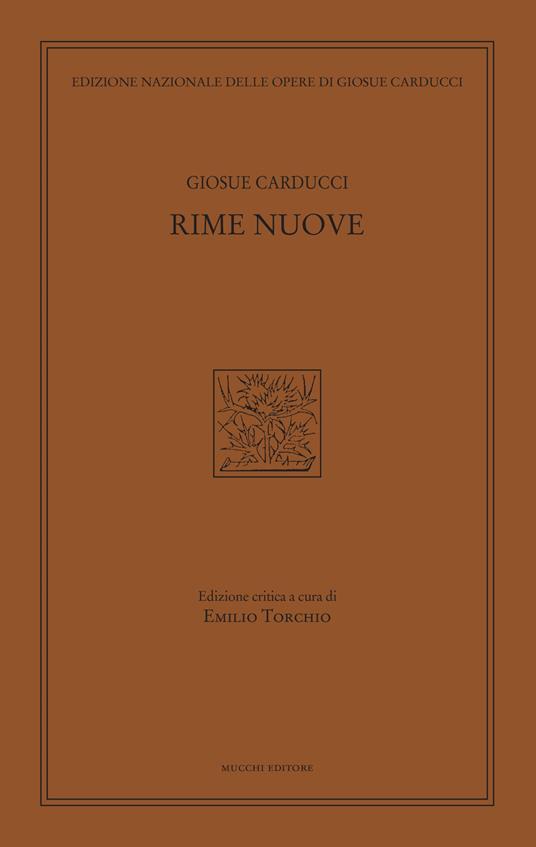
RIME NUOVE / NEW LIRICS
 “>
“>
Autor:
Giosuè Carducci
Country:
Italy (IT)
Book Theme:
The books of the Nobel prizes
Publisher:
Mucchi editore
Publishing Year:
2017
Born in Valdicastello, Tuscany, in 1835, Carducci was deeply involved in the intellectual and political life of Italy, supporting the unification. He became a professor of Italian Literature at the University of Bologna in 1860, a post he held for over 40 years.His poetry is characterized by its classical style, its vibrant historical themes, and its celebration of nature and life. He sought to revive the grand style of ancient Roman and Greek verse, notably in his collection Barbarian Odes. His themes ranged from passionate love and the beauty of the Italian landscape to fierce political rhetoric, reflecting his staunchly secular and patriotic views.Carducci was awarded the Nobel Prize in 1906. He died in Bologna in 1907.
National Award for Children’s and Young People’s
Abstract
Rime Nuove, first fully published in 1887, is one of Giosuè Carducci’s most comprehensive and celebrated collections of poetry, featuring works written over a span of about twenty years (1861–1887). The collection is highly diverse in its subject matter and metrical structures.Rime Nuove is significant because it brings together the “Professor Carducci”—the stern, historical poet—with a more intimate and lyrical side.The collection includes poems that celebrate or evoke moments in Italian history, particularly the Medieval Communal Age (like Il comune rustico), seeing in these periods models of moral and civic virtue lost in contemporary Italy.The collection contains some of Carducci’s most poignant expressions of personal sorrow, most notably “Pianto antico” (Ancient Lament), written after the tragic death of his young son, Dante.The collection marks a transition in Italian literature, blending the classical rigor for which Carducci was known with a newfound Romantic sensibility that allowed for the expression of profound personal feelings and nostalgia. It is widely considered essential for understanding the complexity of his character and his immense contribution to Italian poetry.