


I Malavoglia / Malavoglia
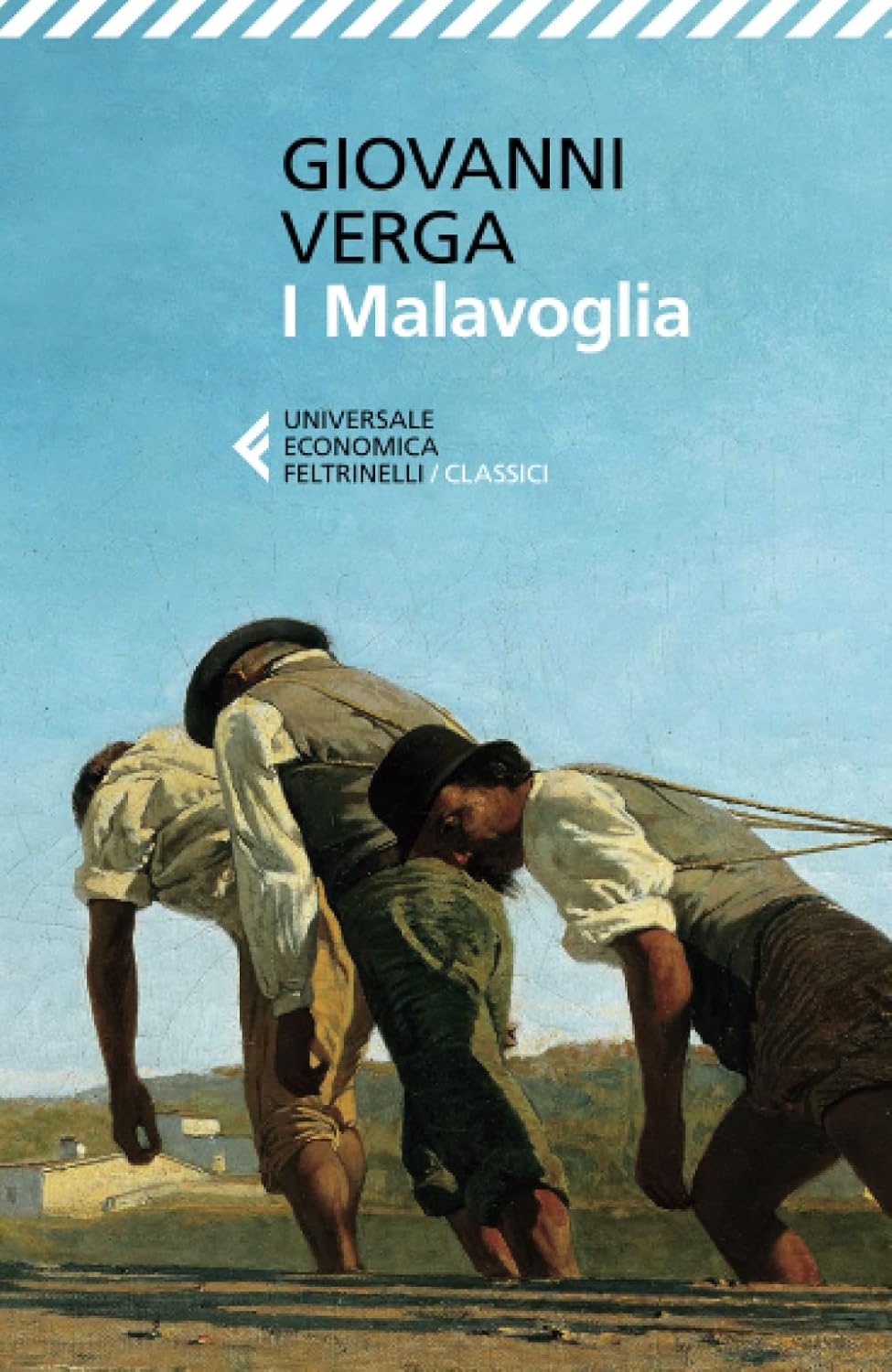 “>
“>
Author:
Giovanni Verga
Country:
Italy (IT)
Book Theme:
Classic novels and Authors representing your country culture
Publisher:
Feltrinelli
Publishing Year:
2014
Giovanni Verga (1840–1922) was an Italian novelist, playwright, and the leading figure of the Verismo literary movement. Born in Catania, Sicily, he began writing romantic novels but later turned to realism, focusing on the lives of the poor and working class in southern Italy. His most famous works include I Malavoglia and Mastro-don Gesualdo, which portray the struggles of ordinary people with stark objectivity. Verga’s concise style and focus on regional dialects helped define modern Italian narrative fiction.
National Award for Children’s and Young People’s
Abstract
Set in Aci Trezza, a small fishing village in the province of Catania, the novel tells the story of the Toscano family, nicknamed “Malavoglia”, an ironic nickname that contrasts with reality: the family has always been anything but lazy, instead constant and hardworking. Through the story of this family, Verga captures what life was like in Sicily in the second half of the 19th century, highlighting archaic dynamics, communal values, and the harsh laws of existence that govern the lives of the protagonists. The plot revolves around the figure of Padron ‘Ntoni, the family patriarch, who lives with his children and grandchildren in the “house of the medlar tree” (“casa del nespolo”), a symbol of familial stability and honor. The family, initially united and respected, is gradually overwhelmed by a series of unlucky events, which begin when ‘Ntoni, the eldest of the grandchildren, leaves the family unit to live in Naples. From there, he starts sending letters back home, describing life as entirely different: cheaper, less exhausting, but more fulfilling, and gradually begins to
distance himself from the family.
After some time, on a tragic and cold Sunday in September, a turning point for the Longa, the
housewife, is the death of her son Bastianazzo at sea, during a journey to trade lupins. A string
of further misfortunes follows: financial ruin, the loss of the house, and the personal tragedies of
the grandchildren. The novel is an essential example of the Verismo literary movement, of which Verga is one of the main exponents. He adopts an impersonal style, renouncing all subjective commentary and using a language that reflects the popular speech, full of proverbs, idiomatic expressions, Latinisms, and syntactic constructions typical of Sicilian dialect. This narrative style allows
Verga to make the narrator’s voice indistinguishable from that of the community and characters, strengthening the effect of realism and direct involvement.
One of the central aspects of the work is the depiction of the “cycle of possessions” (“ciclo della roba”), the deep-rooted attachment of peasants and fishermen to property and labor as the only means of dignity and survival. The loss of the “house of the medlar tree” (“casa del nespolo”) symbolically marks the downfall of the Malavoglia, not only from an economic point of view but also from a moral and identity-based one. The novel thus presents a tragic and deterministic view of the human condition: every attempt at change or emancipation from one’s social destiny is doomed to fail.
I Malavoglia is also a work full of fatalism: events seem to be driven by a higher and inescapable force, almost like a God that punishes any deviation from the natural and traditional
order. The community of Aci Trezza acts as a harsh and conservative judge, ready to
marginalize anyone who deviates from its rules. The characters do not know how to live outside
of this world, as seen with ‘Ntoni, who in the end is forced to leave the village. On the other
hand, Alessi, the youngest brother, represents a return to order, the last hope of rebuilding the
family along the lines of its original values: work, sacrifice, silence. From a thematic point of view, the novel addresses fundamental issues such as the relationship between the individual and society, tradition and modernity, destiny and freedom. The Malavoglia embody Verga’s ideal of an ancient and static world, where every element of progress is viewed with suspicion and where survival depends on family bonds and acceptance of one’s role. So, the tragic arc of the Malavoglia represents only a small part of the broader drama of Italy in the late 19th century, where the rural South clashes with the contradictions of the modern state and, at the same time, with progress-issues that, in fact, still affect Southern Italy today. In conclusion, “I Malavoglia” is much more than a family chronicle: it is a realistic novel that reflects Verga’s bitter and pessimistic view of the human condition. With his sober and penetrating writing, the author transforms the story of a single family into a universal reflection
on the human condition, on the hardship of living, and on the inevitability of suffering. The work remains today one of the most important pieces of Italian literature and a powerful tool for understanding the society, culture, and identity of Southern Italy in the past.