


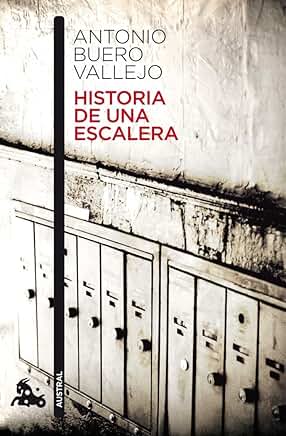
HISTORIA DE UNA ESCALERA / STORY OF A STAIR WAY
 “>
“>
Author:
Antonio Buero Vallejo
Country:
Spain (ES)
Book Theme:
Contemporary writers of your country
Publisher:
AUSTRAL
Publishing Year:
2010
Spanish playwright considered one of the most important playwrights of the 20th century. His work, marked by the Spanish post-war period and censorship, deals with themes such as injustice, oppression and the search for truth. Among his most outstanding works are Historia de una escalera, El concierto de San Ovidio and El tragaluz.During the Spanish Civil War, he enlisted in the Republican army and was imprisoned after Franco’s victory. After his release, he began to write theatre and gained recognition with Historia de una escalera. He became a benchmark in Spanish theatre, tackling social and political issues with courage and depth, denouncing social inequalities and the consequences of dictatorships. His characters struggle to find the truth in a world full of deceit and manipulation.
National Award for Children’s and Young People’s
Abstract
It is a play, set in a neighbour’s staircase, where the lives of several families unfold over three generations. The play explores the frustration, broken dreams and social immobility of the post-war Spanish lower-middle class. The staircase will be the symbol of an oppressive and limited environment, where the characters struggle for their dreams in a context of social passivity and the aspirations of each generation will be truncated by the same limitations, repeating patterns of failure. The protagonists live in the hope of improving their situation, but face the reality of a society that prevents them from advancing, and as time goes by they will see how the dreams of youth fade with age, while personal relationships deteriorate. The play also reflects the social and economic inequality of the time, showing the differences between the characters and their prospects for the future. The search for individual and collective freedom is posed in the face of the fatality of fate and social structure. The love triangles, together with the relationships between the families, reflect the complexity of the social and personal dynamics in an environment of limitations and frustrations. The play, through these characters, invites us to reflect on the human condition and the search for happiness in an adverse social context.