


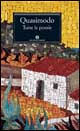
GIORNO DOPO GIORNO / DAY AFTER DAY
 “>
“>
Autor:
Salvatore Quasimodo
Country:
Italy (IT)
Book Theme:
The books of the Nobel prizes
Publisher:
MONDADORI
Publishing Year:
1995
Born in Modica, Sicily, in 1901, he initially studied to be an engineer but later worked for the Civil Engineering Department across various parts of Italy, which exposed him to different regional cultures.Quasimodo was a key exponent of Hermeticism in Italian poetry, characterized by a concentrated, often difficult language and deep lyrical focus on personal experience. His early works, like Acque e terre (1930), evoke the beautiful, but isolated, landscape of Sicily.Following World War II, his poetry shifted towards a more socially engaged stance, addressing the themes of war, ruin, and the tragic modern human condition. His later works, such as Giorno dopo giorno (Day After Day), express despair but also solidarity.Quasimodo died in Naples in 1968.
National Award for Children’s and Young People’s
Abstract
it is a pivotal collection of poetry by Salvatore Quasimodo, first published in 1947 (following an earlier version in 1946 titled Con il piede straniero sopra il cuore—With the Foreign Foot on the Heart). It marks a decisive and profound shift in the poet’s style and thematic focus.
Historical Context: The poems were largely written while Quasimodo lived in Milan during the devastating bombings and German occupation of Italy during World War II (1943-1945).
This work sees Quasimodo abandon the dense, intensely personal, and symbolic language of Hermeticism—which characterized his early career—in favor of a more accessible, communal, and ethically engaged voice.
The collection serves as a direct, lyrical testimony to the tragedy of the war and the suffering of the Italian people.
The poems shift from the solitary “I” to a collective “we.” Quasimodo voices the shared anguish and moral devastation of his generation, emphasizing that the suffering is not personal, but belonging to the entire human community.The opening poem, “Alle fronde dei salici” (To the Willow Branches), is the collection’s manifesto. It famously asks: “And how could we sing / with the foreign foot upon the heart?” This reflects the poet’s belief that in the face of atrocity, poetry’s traditional lyrical function must be suspended or fundamentally changed. The lyre is hung up on the willow, symbolizing the temporary impossibility of creating beautiful, disengaged art.The collection expresses horror at the violence, the destruction of ancient cities (like Milan and Naples), and the loss of innocence. It implicitly criticizes humanity’s failure to learn from history, suggesting a profound moral sickness.
Despite the despair, there is an underlying current of hope and utopian aspiration. Quasimodo suggests that from the ashes of war must emerge a “new man” capable of fraternity and peace, urging future generations to forget the violence and break the cycle of conflict.
In essence, Giorno dopo giorno is a powerful testament to the destruction of war, transforming the poet from a secluded intellectual into a civic conscience and chronicler of collective pain.