


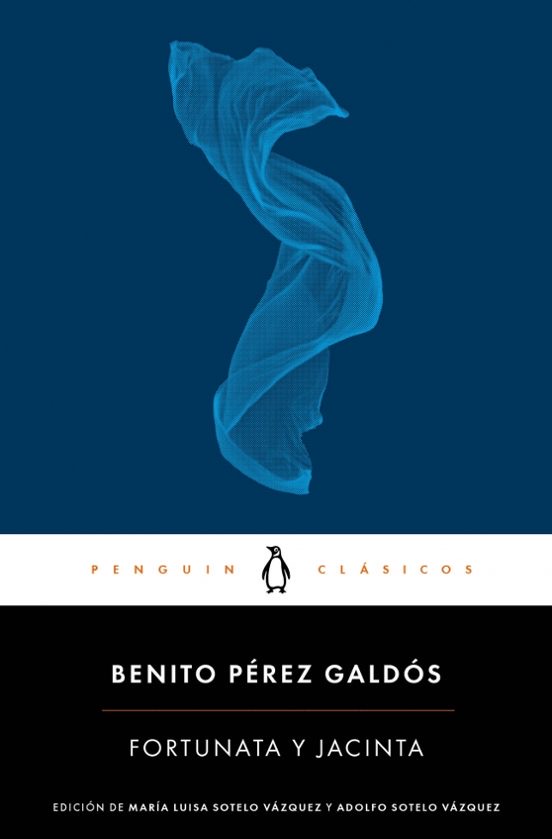
FORTUNATA Y JACINTA / FORTUNATA AND JACINTA: Two Stories of Married Women
 “>
“>
Author:
BENITO PÉREZ GALDÓS
Country:
Spain (ES)
Book Theme:
Classic novels and Authors representing your country culture
Publisher:
Penguin Clásicos
Publishing Year:
2024
Benito Pérez Galdós was a Spanish novelist, playwright and politician.
He is widely considered the greatest Spanish novelist since Cervantes.
After moving to Madrid in 1862 to study law, he abandoned his studies to devote himself to journalism and literature.
He developed two important series of novels:
– The “Episodios Nacionales” historical novels about Spain’s 19th-century events.
– The “Novelas españolas contemporáneas” dealing with contemporary Spain of his time; Fortunata y Jacinta belongs to this second group.
His work is characterised by vivid social realism, detailed portrayal of Madrid society, psychological depth, and a broad cast of characters.
He also engaged in politics, and was a deputy in the Spanish parliament.
National Award for Children’s and Young People’s
Abstract
Fortunata y Jacinta, published in four volumes between 1886 and 1887, is considered a masterpiece of Spanish realist fiction.
The novel is set mainly in Madrid during the turbulent years of the period 1869-76, the Revolutionary Six-Year Period, the First Spanish Republic and the beginning of the Bourbon Restoration.
It intertwines the lives of two women from very different social classes: Fortunata, a working-class woman passionately in love with Juanito Santa Cruz, but whose life is marked by social limitations.
Jacinta, a bourgeois woman, legally married to Juanito Santa Cruz, whose marriage is comfortable but emotionally unstable.
Juanito Santa Cruz, the charming but irresponsible heir, oscillates between his bourgeois marriage to Jacinta and his relationship with Fortunata. The novel explores themes such as social class, gender, marriage, social mobility, morality, and the psychology of its characters.
As the story progresses, the social transformations of Madrid and Spain loom in the background; the city itself becomes almost a character. In the end, the lives of Fortunata and Jacinta converge in a tragic and moving way: Fortunata, on her deathbed, sends her newborn son to Jacinta, who cannot have children of her own.