


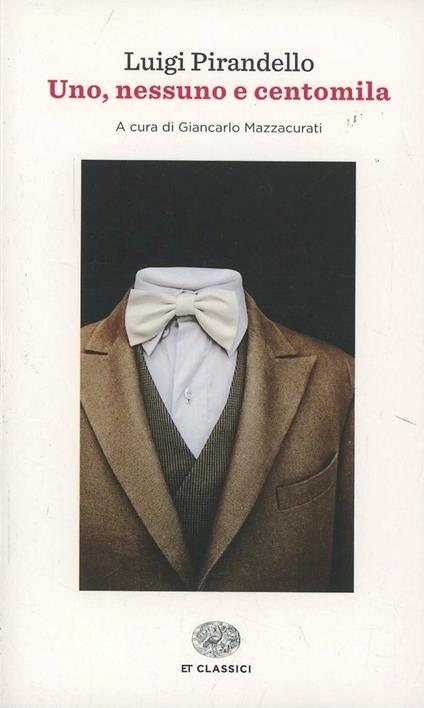
Uno, nessuno, centomila / One, none and one hundred thousand
 “>
“>
Author:
Luigi Pirandello
Country:
Italy (IT)
Book Theme:
Classic novels and Authors representing your country culture
Publisher:
Einaudi
Publishing Year:
2014
Luigi Pirandello was an Italian dramatist, novelist, and short story writer, renowned for his exploration of identity, reality, and illusion. Born in Agrigento, Sicily, he studied philology in Rome and Bonn. His most famous works include the play Six Characters in Search of an Author and the novel The Late Mattia Pascal. Pirandello challenged traditional narrative and theatrical forms, pioneering modernist drama. His themes often focus on the fluidity of the self and the conflict between appearance and truth. He received the Nobel Prize in Literature in 1934 for his bold and innovative contributions to drama and literature. Pirandello died in Rome in 1936.
National Award for Children’s and Young People’s
Abstract
The protagonist of this story, Vitangelo Moscarda is an ordinary person, who inherited his father’s bank as a young man and lives on income. The story, narrated in first person, begins with an apparently insignificant detail: his wife Dida points out to Moscarda that her nose is slightly tilted to the right. This banal observation becomes for him the beginning of an existential drama. He realizes, in fact, that the image he has of himself is different from that which others have of him, and that everyone perceives it differently. From this awareness comes an obsession: to understand who he really is. But the search soon proves impossible, since its identity is not unitary but multiple, fragmented in as many versions as there are people who know it. He is, therefore, “one hundred thousand”, but at the same time “none”, because none of these images coincide with his true self, which perhaps does not even exist.Moscarda, tries to destroy the masks that others attribute to him, coming to perform paradoxical and provocative actions to expose social hypocrisy and break with the role assigned to him. He tries to free himself from the image of the “good bourgeois” and “pawn shop” built by his father, acts against his own economic interests, detaches himself from affections and society. In doing so, however, he discovers that every gesture, even the most rebellious, generates new images, new “Moscarda” in the eyes of others. There is no way out of the game of representations.
Moscarda finds himself stuck in a complicated situation, where reality appears to him divided into many different versions, depending on how others see it. His private life is also affected: the relationship with Dida worsens, because he understands that even love between them is based on roles and expectations imposed by society. Vitangelo realizes that there has never been a real connection with her either, but only a relationship made up of pretenses and fake behaviors. Moscarda comes to an extreme conclusion: the only way to be truly free is to stop having a fixed identity. Only by letting go of the idea of a stable “I” can he feel free. At the end of the book, he moves away from everything and everyone, rejects every role, every label, every bond. Live day by day without thinking about the past or the future, trying to be part of the continuous change in life