


La Divina Commedia- Paradiso / Divine Comedy – Paradise
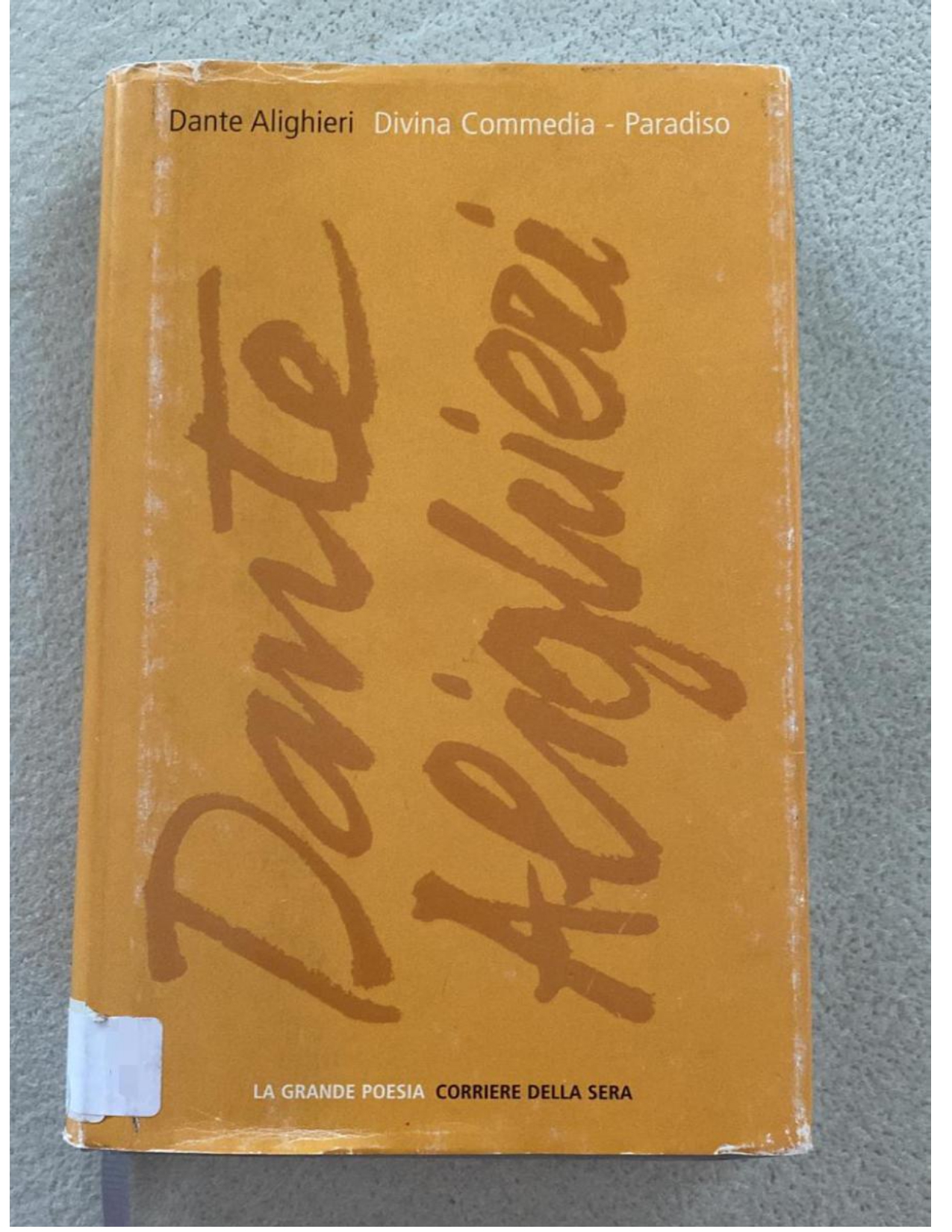 “>
“>
Author:
Dante Alighieri
Country:
Italy (IT)
Book Theme:
Poets representing your country poetry
Publisher:
La Grande Poesia – Corriere della Sera
Publishing Year:
2021
Dante Alighieri (c. 1265–1321) was an Italian poet, writer, and philosopher. His “Divine Comedy,” an epic poem detailing a journey through Hell, Purgatory, and Paradise, is considered a masterpiece of world literature and a foundational work of the Italian language. Born in Florence, he was exiled in 1302 due to political conflicts. He spent his remaining years in Ravenna, completing his magnum opus before his death. Dante’s work profoundly influenced Western thought and literature.
National Award for Children’s and Young People’s
Abstract
Paradise, the third cantica of The Divine Comedy by Dante Alighieri, represents the
conclusion of a journey that began in the dark forest and ends with the soul’s ascent to the
vision of God. After Inferno and Purgatorio, realms of suffering and hope, Dante leads us
into the kingdom of bliss, where celestial order unfolds in perfect harmony. In this edition
by La Grande Poesia (Corriere della Sera), with the valuable commentary by Giorgio De
Rienzo and notes by Ludovico Magugliani, the reader is guided through the complexity of
the text with a clear and enlightening approach, which conveys the theological and poetic
depth of the work.
Paradise consists of 33 cantos (like Purgatorio), each following the chained tercet structure
in hendecasyllabic meter. The setting is no longer earthly: here, the ascent is heavenly, and
each sphere Dante passes through corresponds to a virtue, a planetary sphere, and a
theological order. The journey is marked by encounters with historical, mythological, and
religious figures that embody Christian thought and the ideal harmony between faith and
reason.
Beatrice, who replaces Virgil as a guide, represents not only divine love but also theology
and grace. Her role is crucial: she interprets the heavenly mysteries for Dante and leads him
through the spheres of the Moon, Mercury, Venus, the Sun, Mars, Jupiter, and Saturn, up to
the Empyrean, the realm of God and the blessed. The final guide, Saint Bernard, introduces
Dante to the ultimate vision, culminating in the intuition of the Trinity and the divine love
that “moves the sun and the other stars.”
The main themes of the cantica are divine justice, human Intellect, faith, light, love, and
eternal glory. Dante reflects on the role of humanity within the divine plan and on the
relationship between science and faith, engaging in a constant dialogue with the teachings
of Saint Thomas Aquinas and Aristotelian philosophy. The figures encountered—such as
Piccarda Donati, Justinian, Thomas Aquinas, Saint Francis, Saint Dominic, and Cacciaguida
(Dante’s own ancestor)—embody virtue, memory, and political vision.
This cantica stands out for its high level of abstraction and complexity of imagery. Light
becomes a constant symbol of divine truth, and music, harmony, and geometry are used to
express what is ineffable. Poetry reaches one of its highest points here: Dante strives to
communicate with human words what transcends human understanding, often relying on bold metaphors and symbolic language to suggest, rather than explain, the mystical experience