

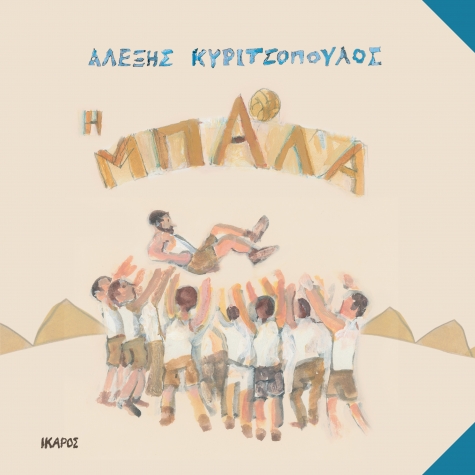
Η ΜΠΑΛΑ / THE BALL
 “>
“>
Author:
ALEXIS KYRITSOPOULOU
Country:
Greece (GR)
Book Theme:
Evergreen children’s book (8-12 years)
Publisher:
IKAROS
Publishing Year:
2023
Born in Athens in 1943, he studied Law at the Athens Law School (1962-1965) but never graduated. In summer of 1967 he moved to Paris. He attended the Printmaking Course at the École nationale supérieure des Beaux-Arts. In 1970 he attended the École des Recherches sur les Arts plastiques et l’ Environnement. Since 1975, when he moved back to Greece, he has been making illustrations for books, posters, book and LP covers, solo exhibitions. He has also been working with the universities of Thessaloniki and Ioannina on illustration projects for textbooks of the French language for Primary and Secondary Education. He has also published books with stories based on poems by famous Greek poets of the 1930s Generation (Seferis, Engonopoulos, Ritsos, Sarantaris).
National Award for Children’s and Young People’s
Abstract
On an island of exile, many years ago, arrives the family of the commander: his wife and two children, returning for a kind of vacation in a place of isolation. Among the exiled prisoners lives a painter, banished for his political beliefs. When the commander’s wife asks him to paint a portrait of her children, the painter agrees on one condition: in return, he asks only for a ball, so that his fellow prisoners can play.
When the ball finally reaches the hands of the exiles, its arrival, and later its prohibition, becomes a turning point. The prisoners seize the moment to play, not just with the ball, but with their imagination, their movement, their inner freedom amid confinement. Yet their joy is abruptly interrupted when the ball is taken away again, a gesture of authority and control. Still, imagination cannot be confiscated. The painter and his companions discover how “the ball is really played” not only with feet or hands, but through creativity, invention, and solidarity. That brief moment of play, the return of the ball, becomes a symbol of freedom, community, and dignity.
Through simple words and rich illustration, the story becomes an allegory about the power of imagination, the creative resistance against confinement, and the meaning of play — not merely as entertainment, but as an act of freedom. For both young and adult readers, it raises a quiet question: what does it mean to “have the ball” in your hands — and what does it mean to have it back again? The ball is not only a game of football; it is an idea, a motion, a spark of imagination — people united against isolation.