

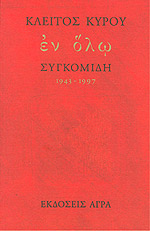
ΕΝ ΟΛΩ (ΣΥΓΚΟΜΙΔΗ 1943-1997) / IN TOTAL (HARVEST 1943-1997)
 “>
“>
Autor:
KLEITOS KYROU
Country:
Greece (GR)
Book Theme:
Contemporary poets of your country
Publisher:
AGRA
Publishing Year:
2006
Kleitos Kyrou was born on 13.8.1921 in Thessaloniki and died on 10.4.2006, at the age of 85. He worked in the banking sector from 1951 to 1983. He served as general secretary of the State Theatre of Northern Greece from 1974 to 1976. He collaborated with many literary magazines, while his poems have been translated into various languages. He was involved in film criticism. He also translated foreign poetry (especially Eliot, Pound, MacLeish, Auden, Keats, Apollinaire, Chantrard, Lorca, Neruda) and theater (Ford, Marlowe, Lorca, Shelley). In November 2001, his autobiographical book “Regressions: A Life’s Reflection” was also published by Agra Publications.
National Award for Children’s and Young People’s
Abstract
In the volume “In total (harvest 1943-1997)” (En Olο) Kleitos Kyrou, one of the most important post-war creators, gathers the fruits of a poetic production of approximately 50 years. The work of the Thessaloniki poet, which appeared in letters in 1949 with the collection “Anazhitasi”, can be schematically divided into two major periods: the first which includes, in addition to his original testimony, the works “Exxi kaimoi”, “Se proto persoso”, “Kravges tis Nykhtas” and the second which includes the collections “Kleidarithmoi”, “Ta poulias kai ih avypnisi”, “Periodos gratos”, “Prothysteros logos”.
To the poems of the first period, K. Kyrou also owes the “labels” of the social poet or the poet of the generation of defeat.
However unfair these “labels” may be, the truth is that many of the verses of this period were dictated by the charged climate and experiences of the critical fifteen years of 1943-58. “The soldiers fled hunched over with broken triads/ Women with bundles on their shoulders/ Citizens laden with gold and terror/ The steamers whistled with despair/ The passengers huddled together pale and doubtful/ The port burned like a Christmas tree.” However, what differentiates Kyros’ poetry from similar statements by his contemporaries and fellow artists is an ironic gaze of Karyotaki origin and a lyricism oriented towards Greek landscape. “Some summer we will return/ stronger, more satiated/ disciplined by the nostalgia of the Aegean.” In the poems of the second period, which have as their setting less “glorious” days, lyricism recedes, social tension is crushed by the invasion of metaphysics, the discourse becomes denser. By shedding their lyrical ornaments, his verses operate on more levels, revealing their tragic depth. The poet, by retelling himself, retells his era better.
“He did not show anyone his trauma/ Advanced disability/ And yet above all suspicion/ At night he would open secret drawers/ He would stretch out limbs artificially in the mirror/ He would assemble ages, smiles/ In the morning he would sigh defeated and withdraw/ Someday they would discover his weakness, it was inevitable/ Incompatible with his profession after all/ He was an estimator of time.” The above poem with the indicative title “Prosopeio”, from the collection “Kleidarithmoi”, is characteristic of the poetic maturity that the creator approaches and conquers in his second period. Helping in his entire effort is the appearance of some absurd elements, which seem to dominate his latest works. A flirtation with the poetry of the absurd as defined by G. Dallas, an eclectic perhaps affinity with Miltos Sachtouris.
Those who know the extensive translation work of K. Kyros, for which he was honored with the corresponding state award, reading his collected volume “In total (harvest 1943-1997)” (En Olο), should take into account that his effort to transfer the most important poetic voices of the century to our language left his own voice unscathed, his speech remained pure, maintaining its consoling power to this day.